London School of Hygiene & Tropical Medicine BASIC MATHS SUPPORT SESSIONS Outline of each Session The Basic Maths refresher will consist of 5 sessions as follows: Session
1: fractions, decimals, percentages, rounding, ratios and proportions, order of operations (brackets), simple calculator arithmetic; Session
2: simple algebra, simple equations, simple inequalities, using and rearranging formulae; Session
3: simple graphs, applied problem solving and probabilities (using ‘mathematical thinking’), exponents (powers) and standard form (including calculator use); Session
4: logarithms (including calculator use), transforming a curve to a straight line graph; Session
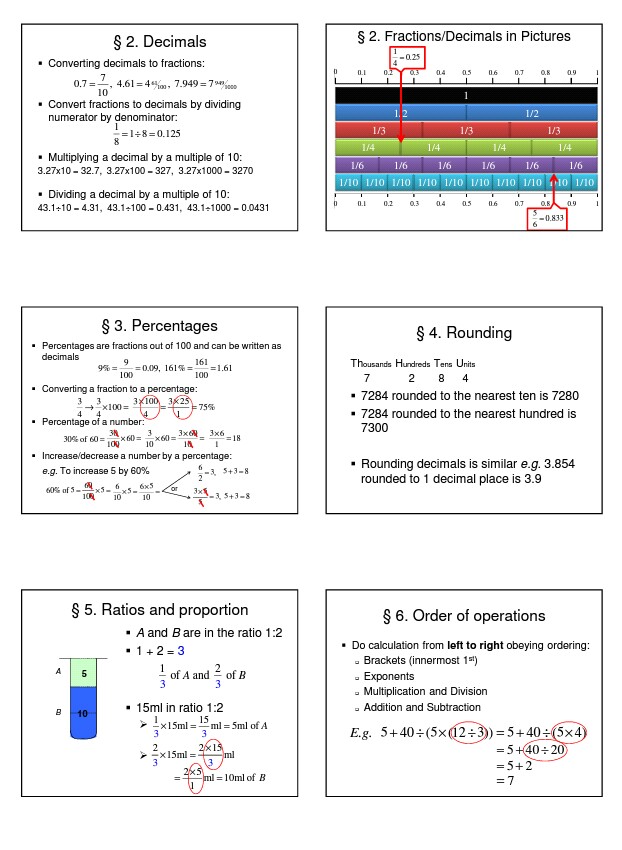
5: drop-in for further practice of exercises from Sessions 1-4 (but no formal teaching / new slides). Each session lasts for one and a half hours, although 10 minutes at the start and end of each session will be allotted for moving between classrooms. We hope that these sessions will allow you to follow the mathematical content in some of the MSc Study Modules, such as those with ‘Statistics’ or ‘Epidemiology’ in the title. Your tutors will welcome your questions, so please do not hesitate to ask if you need assistance. The recommended calculator is the Casio fx-85GT PLUS. You may already have a different calculator that you are comfortable with using. If so, you do not need to rush out and buy this model. However, the tutors may not be familiar with the intricate details of your calculator model! Books such as GCSE maths exam revision guides will contain much of this material. The LSHTM Study Skills web page can provide you with further support . On this webpage you will find LSHTM’s online interactive Basic Maths self-assessment tool, and links to a number of external maths revision websites (under the subheading ‘Maths and Numeracy Skills’). You may find it helpful to have a look at these if you require some additional worked examples. They will also help to reinforce what you have done during these sessions. You can also enrol for the sessions via the interactive Basic Maths self-assessment tool. Aims and Objectives of Session 1 At the end of this session you should have some basic knowledge of the following key concepts in arithmetic: fractions, decimals, percentages, rounding, ratio and proportion and order of operations. You should also have some understanding of the use of calculators in arithmetic and some indication of topics in your Term 1 modules which use these techniques. In particular you should be able to: 1) add, subtract, multiply and divide fractions 2) convert fractions to decimals and decimals to fractions, multiply and divide decimals by multiples of 10 3) change a fraction to a percentage, find a percentage of a number, increase/decrease a number by a percentage 4) round whole numbers and decimals
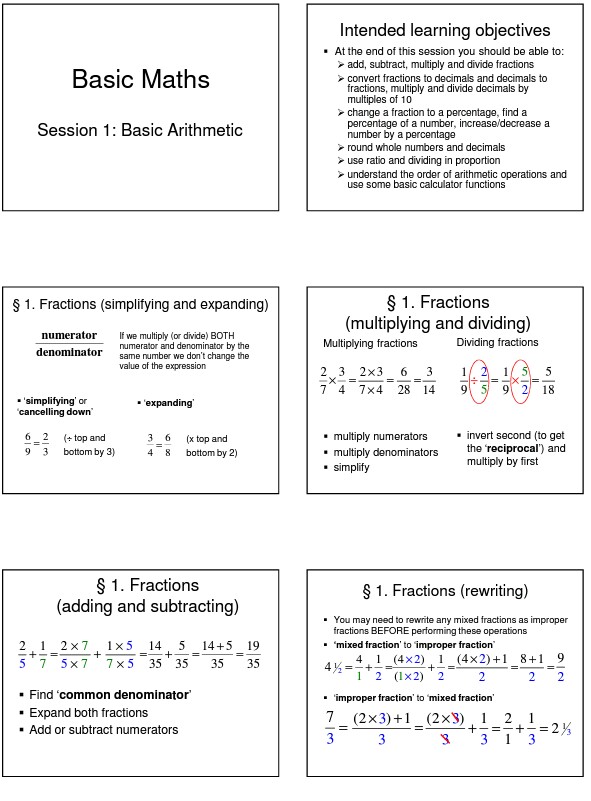
5) use ratio and dividing in proportion BASIC MATHS – OUTLINE
6) understand the order of arithmetic operations and use some basic calculator functions Aims and Objectives of Session 2 At the end of this session you should have some basic knowledge of the following key concepts in algebra: algebraic expressions, simple equations, simple formulae and inequalities, and some indication of topics in your Term 1 modules which use these techniques. In particular you should be able to: 1) substitute numbers for letters in algebraic expressions 2) multiply out brackets and use factorisation 3) solve simple equations 4) use and rearrange simple formulae 5) solve simple inequalities Aims and Objectives of Session 3 At the end of this session you should have some basic knowledge of key concepts in graph drawing, problem solving, powers of numbers, and some indication of topics in your Term 1 modules which use these techniques. In particular you should be able to: 1) understand the terminology of graphs and use axes, scales and co-ordinates 2) plot simple graphs 3) understand the equation of a straight line and use it to plot straight line graphs 4) understand and solve problems involving unit quantities 5) understand and solve problems using probability trees 6) use the rules for indices (multiply and divide powers, raise a power to a power, reciprocals) 7) understand what is meant by standard form and convert numbers to standard form Aims and Objectives of Session 4 At the end of this session you should have some basic knowledge of the following key concepts in logarithms and some indication of topics in your Term 1 modules which use these techniques. In particular you should be able to: 1) understand the concept of logarithms, inverse logs and natural logs 2) understand and use the rules of logs 3) use the log function on the calculator 4) transform non-linear to straight line graphs using logs

 PPSC,FPSC,NTS,OTS Test Preparation