- Istalam is kissing of Hajr Aswad.
- Islam has 2 major sects.
- There are 5 fundaments of Islam.
- 2 types of faith.
- 5 Articles of faith.
- Tehlil means the recitation of Kalima.
- Deen-e-Hanif is an old name of Islam.
- First institution of Islam is Suffah.
- Haq Mahar in Islam is fixed only 400 misqal.
- Ijma means ageing upon any subject.
- There are four schools of thought of Islamic Law.
- Janatul Baki is situated in Madina.
- Masjid-e-Hanif is located in Mina.
- JANAT UL MOALA is a graveyard in MECCA.
- Qazaf: false accusation of adultery punishable with 80 lashes.
- Lyla-tul-Barrah means the Night of Forgiveness.
- Karam-un-Katibin means Illustrious writers.
- Oldest mosque on earth is Kaabatullah.
- 1st Kalima=Tayyab, 2nd =Shahadat, 3rd =Tamjeed, 4th =Tauheed, 5th =Astaghfar, 6th =Rad-e-Kufar
- Qiblah means anything in front.
- Saabi is one who changes his religion.
- Sidrat-ul-Mantaha means last tree of the Eternity.
- Jaabi is one who collects Zakat.
- First collection of Ahadith is Sahifah-e-Saadiqa.
- Saying of Prophet are called Wahi Ghair Matlloo.
- In iman-e-Mufassal essential beliefs are 7 in number.
- The most exalted angels are four.
- Greatest angel as per Islam is Jibra’eel.
- Each human being is attended permanently by two angels
Basic arithmetic part 1
London School of Hygiene & Tropical Medicine BASIC MATHS SUPPORT SESSIONS Outline of each Session The Basic Maths refresher will consist of 5 sessions as follows: Session
1: fractions, decimals, percentages, rounding, ratios and proportions, order of operations (brackets), simple calculator arithmetic; Session
2: simple algebra, simple equations, simple inequalities, using and rearranging formulae; Session
3: simple graphs, applied problem solving and probabilities (using ‘mathematical thinking’), exponents (powers) and standard form (including calculator use); Session
4: logarithms (including calculator use), transforming a curve to a straight line graph; Session
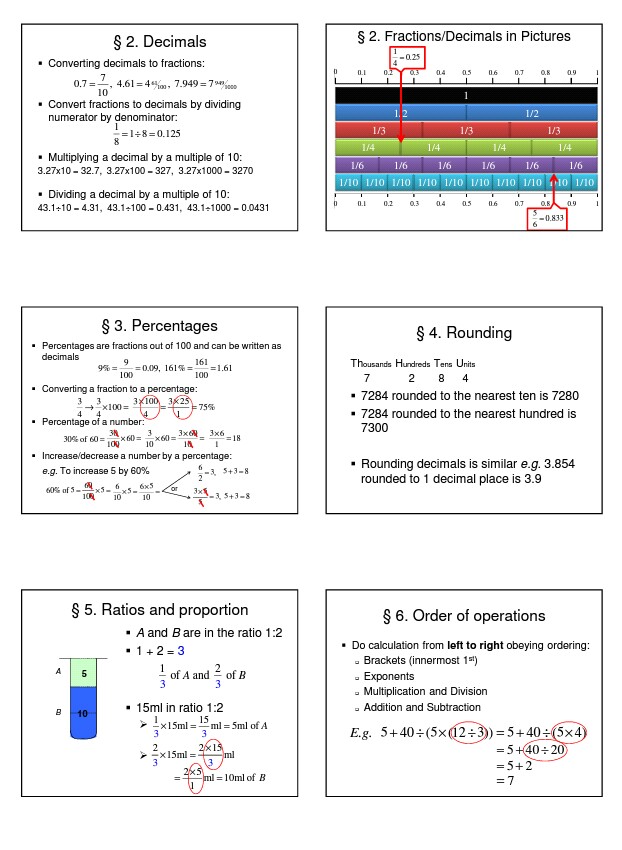
5: drop-in for further practice of exercises from Sessions 1-4 (but no formal teaching / new slides). Each session lasts for one and a half hours, although 10 minutes at the start and end of each session will be allotted for moving between classrooms. We hope that these sessions will allow you to follow the mathematical content in some of the MSc Study Modules, such as those with ‘Statistics’ or ‘Epidemiology’ in the title. Your tutors will welcome your questions, so please do not hesitate to ask if you need assistance. The recommended calculator is the Casio fx-85GT PLUS. You may already have a different calculator that you are comfortable with using. If so, you do not need to rush out and buy this model. However, the tutors may not be familiar with the intricate details of your calculator model! Books such as GCSE maths exam revision guides will contain much of this material. The LSHTM Study Skills web page can provide you with further support . On this webpage you will find LSHTM’s online interactive Basic Maths self-assessment tool, and links to a number of external maths revision websites (under the subheading ‘Maths and Numeracy Skills’). You may find it helpful to have a look at these if you require some additional worked examples. They will also help to reinforce what you have done during these sessions. You can also enrol for the sessions via the interactive Basic Maths self-assessment tool. Aims and Objectives of Session 1 At the end of this session you should have some basic knowledge of the following key concepts in arithmetic: fractions, decimals, percentages, rounding, ratio and proportion and order of operations. You should also have some understanding of the use of calculators in arithmetic and some indication of topics in your Term 1 modules which use these techniques. In particular you should be able to: 1) add, subtract, multiply and divide fractions 2) convert fractions to decimals and decimals to fractions, multiply and divide decimals by multiples of 10 3) change a fraction to a percentage, find a percentage of a number, increase/decrease a number by a percentage 4) round whole numbers and decimals
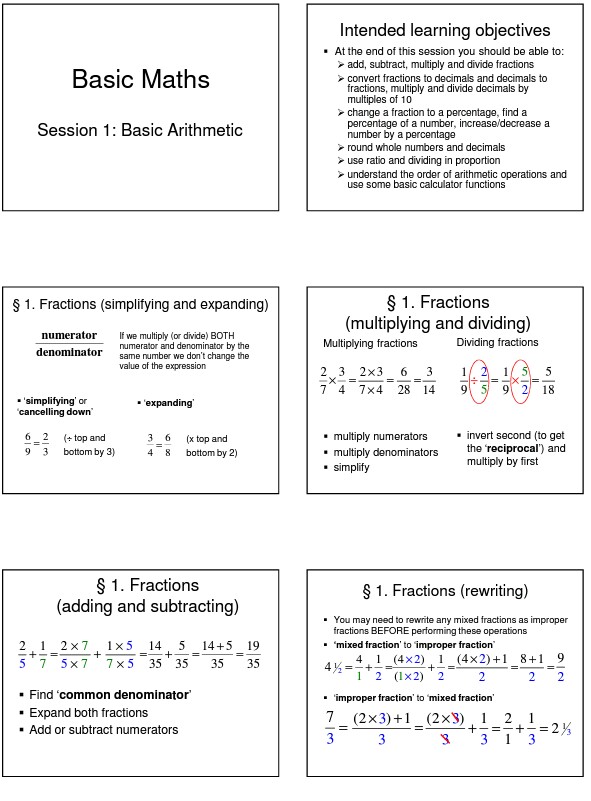
5) use ratio and dividing in proportion BASIC MATHS – OUTLINE
6) understand the order of arithmetic operations and use some basic calculator functions Aims and Objectives of Session 2 At the end of this session you should have some basic knowledge of the following key concepts in algebra: algebraic expressions, simple equations, simple formulae and inequalities, and some indication of topics in your Term 1 modules which use these techniques. In particular you should be able to: 1) substitute numbers for letters in algebraic expressions 2) multiply out brackets and use factorisation 3) solve simple equations 4) use and rearrange simple formulae 5) solve simple inequalities Aims and Objectives of Session 3 At the end of this session you should have some basic knowledge of key concepts in graph drawing, problem solving, powers of numbers, and some indication of topics in your Term 1 modules which use these techniques. In particular you should be able to: 1) understand the terminology of graphs and use axes, scales and co-ordinates 2) plot simple graphs 3) understand the equation of a straight line and use it to plot straight line graphs 4) understand and solve problems involving unit quantities 5) understand and solve problems using probability trees 6) use the rules for indices (multiply and divide powers, raise a power to a power, reciprocals) 7) understand what is meant by standard form and convert numbers to standard form Aims and Objectives of Session 4 At the end of this session you should have some basic knowledge of the following key concepts in logarithms and some indication of topics in your Term 1 modules which use these techniques. In particular you should be able to: 1) understand the concept of logarithms, inverse logs and natural logs 2) understand and use the rules of logs 3) use the log function on the calculator 4) transform non-linear to straight line graphs using logs
Basic point related website
Hello friends its a new website in you prepare your tests easily because in which available all material related PPSC,FFPSC,OTS,NTS, with complete detail or correct material without any mistake or problem please friends visit this website or your close friends or other relatives I hope you like very much thanks to my all sweet visitors thanks a lot .
Every day science part 1
Q.1. Hormones assist in which one of the following activities?
(a) Digestion of food
(b) Activities of enzymes
(c) Regulation of the body process (Correct)
(d) Maintaining on optimum level of pH in the body
Q.2. Urea and Uric acid are formed in the metabolism of
(a) Sugars
(b) Fats
(c) Proteins (Correct)
(d) Minerals
Q.3. The most highly contractile part of human body is
(a) Skin (b) Stomach (c) Urinary bladder (d) Iris (Correct)
Q.4. Which one of the following is a tissue? (a) Liver (b) Heart (c) Skin (Correct) (d) Blood
Q.5. Which one of the following disease is hereditary?
(a) Anemia (b) Nephritis (c) Diabetes (Correct) (d) Night blindness
Q.6. A man suffering from the bleeding of gums is advised to take (a) Milk & carrot (b) Sufficient protein (c) Citrus fruit (Correct) (d) water
Q.7. Our teeth & bone are made of mainly
(a) Calcium hydrogen phosphate (b) Calcium phosphate (c) Calcium sulphate (d) None of these (Correct)
Q.8. Gastric juice is produced in (a) Mouth (b) Liver (c) Pancreas (d) Stomach (Correct)
Q.9. The red blood cell in a human body die after about (a) 150 days (b) 120 days (Correct) (c) 90 days (d) 157 days
Q.10. Of the following organs in human body, largest is (a) Kidney (b) Heart (c) Brain (d) Liver (Correct)
Q.11. What is the approximate mean distance that separates the sun from the earth? (a) 1600,90,000 kms (b) 1480,00,000 kms (Correct) (c) 1500,00,000 kms (d) 1890,70,000 kms
Q.12. The outer surface of the sun is called? (a) Thermosphere (b) Lithosphere (c) Ionosphere (d) Photosphere (Correct)
Q.13. Which planet has the maximum number of satellites? (a) Mars (b) Mercury (Correct) (c) Venus (d) Jupiter
Current affairs part 1
Current Affairs MCQS Set-1
1. Sister Dr Ruth Katherina Martha Pfau actually belong to which Country :
(A) United States of America
(B) Canada
(C) Russia
(D) Germany
- Mother Tressa of Pakistan is the title given to
(A) Hillary Clintion
(B) Ruth Pfau
(C) Anglena Merkel
(D) None of the Above. - Dr Ruth Pfau palyed a vital role in eradication of which disease
(A) Hepatitus A
(B) HIV
(C) Malaria
(D) Leprosy - Which Pakistani National Award Dr Ruth has received for her excellent services for fight against leprosy
(A) Sitara-e- Quaid-e-Azam
(B) Hilal e Imtiaz
(C) Hilal e Pakistan
(D) All of the above. - Dr Ruth died on 10th August 2017 . Her age at the time of death was.
(A) 82 Years
(B) 85 Years
(C) 87 Years
Prime Minister and Cabinet of Pakistan after Panama Case Verdict
Who is the current Prime Minister of Pakistan ?
(A) Mian Shahbaz Sharif
(B) Mian Nawaz Sharif
(C) Shahid Khaqan Abbasi
(D) Ahsan Iqbal
Current Interior Minister of Pakistan is
(A) Chaudary Nisar
(B) Ahsan Iqbal
(C) Khawaja Asif
(D) Talal Chaudary
Current Defence Minister of Pakistan is
(A) Khawaja Asif
(B) Khurrum Dastgir Khan
(C) Ahsan Iqbal
(D) Khawaja Saad Rafique
Current Minister of Foreign Affairs is
(A). Talal Chaudary
(B). Maryam Aurganzaib
(C) Khawaja Muhammad Asif
(D) Ishaq Dar
Current Minister of Information & Broadcasting is
(A) Pervaiz Rasheed
(B) Marvi Memon
(C) Maryam Aurangzaib
(D) None of These
Current Minister of Railway is
(A) Khawaja Saad Rafique
 PPSC,FPSC,NTS,OTS Test Preparation